Developer Land Deals Fall 23% in Jan–Sep 2026, Acreage Down 56% as JDAs Take One in Four Deals: ANAROCK
Developers signed 76 land deals covering about 1,445 acres in January–September 2026, down 23% by count and 56% by area, as joint development agreements rose to a quarter of all deals. Here is what the ANAROCK data shows and what landowners in Delhi NCR and Uttarakhand should check before signing a JDA.
SSite Admin · · 5 views
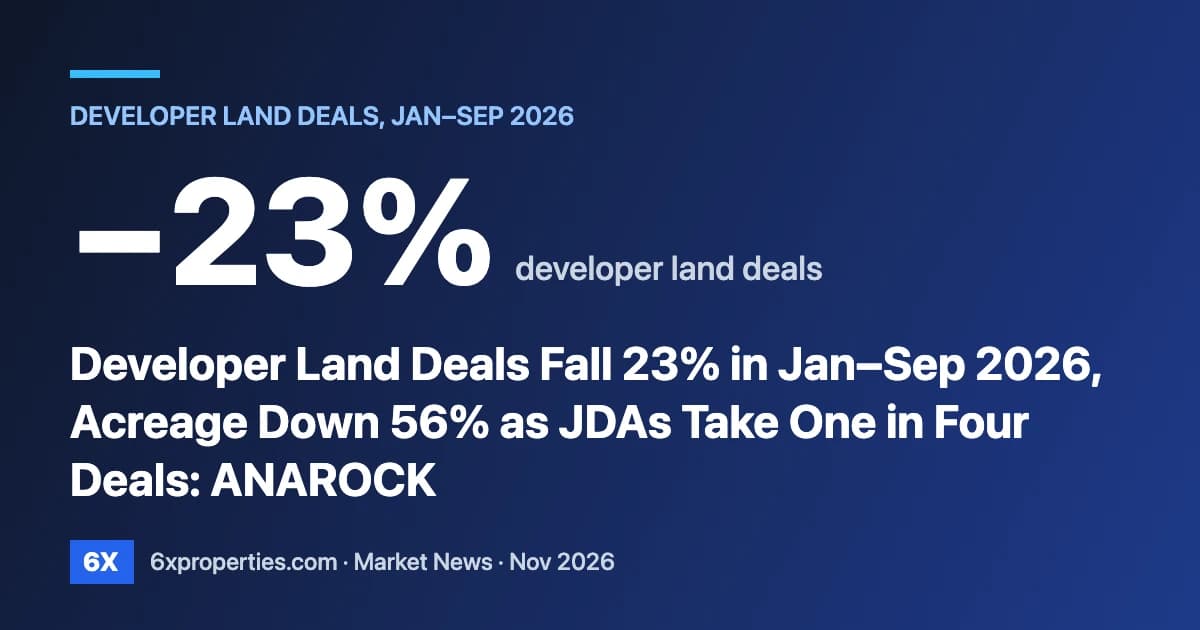
Real estate developers in India bought far less land in the first nine months of 2026 than a year earlier, and more of what they did sign came through joint development agreements (JDAs) with landowners rather than outright purchases. Data from ANAROCK Research & Advisory, released on 11 November 2026, shows 76 land deals covering about 1,445 acres between January and September 2026, against 99 deals over nearly 3,292 acres in the same period of 2025.
Two headline numbers have been doing the rounds since the release, and they measure different things. The 23% fall refers to the number of deals (99 down to 76). The 56% fall refers to the land area acquired (about 3,292 acres down to about 1,445 acres). No transaction value in rupees was disclosed in the reports we read, so neither figure is a measure of money spent.
For landowners in Delhi NCR and in Uttarakhand's Udham Singh Nagar district, the more important takeaway is the second trend: roughly one in four land deals tracked by ANAROCK this year was a JDA. That changes how a builder is likely to approach you, and what you should ask for.
What happened
ANAROCK tracks land transactions by developers across Indian cities. Its January–September 2026 data shows a sharp contraction in both the count and the size of deals. The steepest drop was in large parcels. Deals of 50 acres or more fell from 12 in the first nine months of 2025 to just five this year, and the land covered by those big deals shrank from about 2,398 acres to about 588 acres. In other words, most of the lost acreage came from developers stepping back from very large land buys, not from a collapse in smaller transactions.
ANAROCK linked the slowdown to rising costs and a high base from 2025, which was a record year for acreage. Mayank Saksena, MD and CEO of Land Services at ANAROCK Group, described the period as reflecting "a more cautious and selective acquisition strategy", and said developers are increasingly partnering with existing landowners through JDAs as project economics become more important.
The JDA share has been rising steadily. At least 19 of the 76 deals in 9M 2026 were JDAs, or about 25%. In 2022, JDAs made up about 12% of deals (10 transactions); by 2025 the share had reached about 24% (30 transactions).
Key figures
- Land deals, Jan–Sep 2026: 76, down about 23% from 99 in Jan–Sep 2025
- Land area, Jan–Sep 2026: about 1,445 acres, down about 56% from nearly 3,292 acres
- Deal value: not disclosed in the reports we reviewed
- Large deals (50 acres or more): 5 in 9M 2026, down from 12; area down from about 2,398 acres to about 588 acres
- JDAs: at least 19 of 76 deals, or about 25%, up from about 12% in 2022 and about 24% in 2025
- Year-wise trend: 83 deals and 2,509 acres in 2022; 98 deals and 2,717 acres in 2023; 133 deals and 2,515 acres in 2024; 126 deals and 3,772 acres in 2025
- Cumulative, 2022 to September 2026: 516 deals covering about 12,958 acres
- FY2025-26: 111 land deals covering 2,994 acres, with listed developers accounting for 49% of deals, up from 40% the previous year
- Seven major markets (MMR, NCR, Bengaluru, Hyderabad, Pune, Chennai, Kolkata): about 86% of deals since 2022, but only about 57% of the acreage
- Largest single deals since 2022: 714 acres in Coimbatore, 600 acres in Hyderabad, and 500 acres and 440 acres in Ahmedabad
City breakdown: where NCR stands
ANAROCK's city data in these reports is cumulative for 2022 to September 2026, not for the nine months of this year alone. On that basis, the Mumbai Metropolitan Region, the National Capital Region and Bengaluru led land acquisitions, followed by Ahmedabad and Hyderabad.
The exact NCR acreage needs a caveat. The reports we read quote two different sets of numbers for the same period. One set places MMR at about 2,798 acres, NCR at about 2,012 acres and Bengaluru at about 1,679 acres. Another places MMR at about 1,965 acres, NCR at about 1,570 acres and Bengaluru at about 1,540 acres. The likely explanation is a difference in how deals are counted or classified, but the reports do not say. What is consistent across both is the ranking: NCR is the second-largest market for developer land buying in India since 2022, behind only MMR.
No separate figures were published for Gurugram, Noida, Greater Noida or Ghaziabad, and we have not estimated them. Outside the metros, the Gujarat cluster of Ahmedabad, Surat and Vadodara accounted for about 2,020 acres, or about 16% of tracked acreage, with Ahmedabad alone at about 1,460 acres across 14 deals. Coimbatore recorded about 770 acres. Amritsar, Nagpur, Panipat and Ludhiana were also named as markets with notable deals. Of the 61 deals of 50 acres or more since 2022, 29 were outside the seven established metros, which shows large parcels are increasingly being bought in smaller cities.
Planned use
The reports we read do not break down the land by planned use (residential, commercial, warehousing or mixed use). We have therefore not attributed any split to ANAROCK. Market commentary generally links developer land buying to housing pipelines, but that is not a figure from this dataset.
Why developers are turning to JDAs
A joint development agreement is a partnership between a landowner and a developer. The landowner contributes the land, or the development rights over it. The developer takes on approvals, construction, financing and marketing. Instead of a one-time sale price, the landowner is paid in a share of what gets built or sold.
For a developer, the attraction is simple. Buying land outright ties up large amounts of capital years before a single flat is sold, and land prices in established markets such as Gurugram and Noida have climbed sharply. A JDA cuts that upfront outlay and lowers the developer's exposure to land costs. The capital saved can be used for construction or for taking on more projects at the same time. When project margins are under pressure, as ANAROCK suggests they are, this matters more.
For landowners, a JDA offers the chance to share in the value created by development, rather than selling at today's land price. The trade-off is that you take on part of the project's risk: delays, slow sales and disputes all affect what you eventually receive.
The shift also tells you something about the market. Fewer large outright purchases, combined with a steady rise in JDAs, suggests developers remain keen to build, but want to commit less capital upfront. Listed developers taking a larger share of deals in FY2025-26 also fits a pattern of bigger, better-capitalised firms being more active while smaller players hold back.
What it means for buyers, landowners and investors
For homebuyers
A slowdown in land buying does not immediately change the supply of homes, because projects launched in 2026 and 2027 mostly sit on land acquired earlier. Over a longer horizon, fewer large land deals could mean a thinner pipeline of big townships. If you are comparing projects in Gurugram or Noida, it is worth checking whether a project is on land the developer owns or on JDA land. JDA projects are legal and common, but the title and the agreement between landowner and builder should be clearly reflected in the RERA registration.
For landowners in Delhi NCR
If you own a plot or a farmhouse-size parcel in a developing corridor of NCR, you are more likely now to receive a JDA proposal than a straight purchase offer. Do not treat this as a lesser deal by default. It can be the better deal if the developer is strong and the terms are sound. It can also tie up your land for years if things go wrong.
For landowners in Udham Singh Nagar, Uttarakhand
The trend of large deals moving beyond the metros is relevant to growing towns such as Rudrapur and Kashipur. Landowners near industrial clusters and highways in Udham Singh Nagar may be approached by regional developers for plotted or group housing projects. The same principles apply as in NCR, but the developer pool is smaller and less often listed, so due diligence on the builder becomes even more important. Local market depth also matters: a revenue share in a market where homes sell slowly is worth less than it looks on paper. Browse current listings for property in Rudrapur to get a sense of local prices and how much stock is already on offer.
Revenue share vs area share
JDAs usually take one of two forms.
- Area share: you receive a fixed proportion of the built-up area (for example, a number of flats or floors) once the project is complete. You can then live in, rent out or sell those units yourself. This works best when you trust the location's demand and are willing to wait.
- Revenue share: you receive an agreed percentage of sales proceeds as units are sold. This gives you cash flow tied to sales, but your income depends entirely on the developer's pricing and pace of sales, and on accurate reporting of what was sold.
Some agreements combine both, or add a refundable or non-refundable security deposit paid to the landowner at signing. A security deposit gives you some protection if the project stalls.
The checks to make before signing
- Developer track record: look at completed and delayed projects, RERA complaints and any litigation. Visit an older project and speak to residents.
- RERA registration: confirm the project will be registered with the relevant state RERA, and that your role as landowner and your share are disclosed.
- Clear title and land use: make sure your own title is clean and that the land use permits the intended project. Conversion, licences and approvals should be the developer's responsibility, with timelines in the agreement.
- Identified units: in an area-share deal, the specific units, floors or plots allotted to you should be identified in the agreement, not left to be decided later.
- Timelines and penalties: the agreement should set dates for approvals, start of construction and completion, with penalties or compensation for delay.
- Power of attorney limits: a development power of attorney should be limited to what the developer needs to build and sell its share. Avoid open-ended powers over your share.
- Exit and termination: spell out what happens if approvals are not obtained, if the developer defaults, or if the project is abandoned, including how the land reverts to you.
- Escrow and audit rights: in a revenue-share deal, insist on an escrow or a designated account and the right to see sales records.
- Independent advice: have a property lawyer and a chartered accountant review the draft before you sign. The developer's lawyer works for the developer.
The risks
The main risks are delay, developer financial stress and disputes over accounting. A stalled project can leave your land encumbered for years. If the developer has borrowed against the project, lenders may have claims that complicate your position. In revenue-share deals, under-reporting of sale prices is a common source of dispute. Mitigate these through the checks above, a meaningful security deposit, and clear termination clauses.
Taxation: what the sources say
Tax on JDAs is technical, and this is not tax advice. Tax guidance published under the Income-tax Act, 1961 describes the following rules. For an individual or HUF landowner who signs a registered JDA, capital gains under Section 45(5A) are taxed in the year the project's completion certificate is issued, not when the agreement is signed. The consideration is generally taken as the stamp duty value of the landowner's share on that date plus any cash received. This benefit is lost if you transfer your share before the completion certificate is issued. The developer is required to deduct TDS at 10% on any cash paid to the landowner under Section 194-IC (higher if PAN is not provided). GST may also apply to the transfer of development rights and the construction of the landowner's share. Since the Income-tax Act, 2025 has replaced the 1961 law, ask a chartered accountant to confirm the current section and conditions before you sign.
For investors
For investors, the data supports a few cautious conclusions. Developers are prioritising capital discipline over land banking. NCR remains among the top two markets for land acquisition since 2022, which supports its long-term pipeline. Large parcels in smaller cities are drawing attention, but those markets carry more absorption risk. If you are an owner considering selling or partnering, you can list your property or register your interest as an owner on 6X Properties through our owner registration page.
FAQ
Did land deals fall 23% or 56% in 2026?
Both figures are correct, but they measure different things. The number of land deals fell about 23%, from 99 to 76, in January–September 2026. The land area acquired fell about 56%, from nearly 3,292 acres to about 1,445 acres.
How much money was spent on these land deals?
The reports of ANAROCK's data that we reviewed do not give a total transaction value in rupees, so we cannot say whether spending rose or fell.
How did NCR perform?
ANAROCK's city figures are cumulative for 2022 to September 2026. NCR ranks second behind MMR in land acquired over that period. Reports quote NCR at either about 2,012 acres or about 1,570 acres, depending on the data set, and no separate figures were published for Gurugram or Noida.
What share of land deals are JDAs now?
At least 19 of the 76 deals in January–September 2026, or about 25%, were joint development agreements, up from about 12% in 2022 and about 24% in 2025.
Should a landowner choose revenue share or area share?
It depends on your need for cash, your confidence in local demand and your trust in the developer. Area share suits owners who want flats or plots they can hold or sell. Revenue share suits those who want cash flow but requires strong audit and escrow protections. Take independent legal and tax advice either way.
Sources
- PropNewsTime: Developers turn selective on land acquisitions; JDAs gain share in 9M 2026: Anarock
- PropNewsTime: Rising land costs push developers towards JDAs as outright land acquisitions slow
- The Realty Today: Land buying slows in 9M 2026, 25% of 76 land deals were JDAs as builders turn selective
- Constro Facilitator: JDAs gain share as developers turn selective on land
- Taxbuddy: How to calculate capital gains tax on a joint development agreement
Looking to buy, sell or rent?
Browse verified listings or list your property in minutes.