RBI Hikes Repo Rate to 5.5%: What It Means for Your Home Loan EMI
The Reserve Bank of India raised the repo rate by 25 basis points to 5.5% on 7 October 2026, its first hike since February 2023. Here is how it affects home loan EMIs and what buyers should do.
SSite Admin · · 14 views
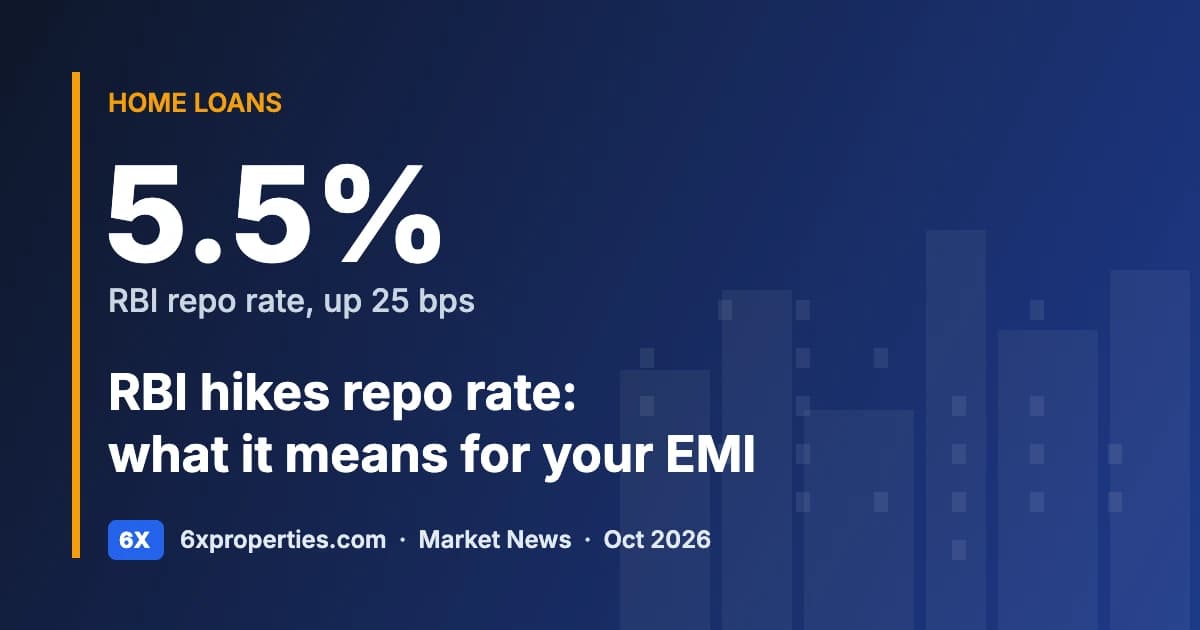
The Reserve Bank of India (RBI) raised its key lending rate, the repo rate, by 25 basis points to 5.5% on 7 October 2026. It is the RBI's first rate hike since February 2023, after the rate had held at 5.25% through the August review.
The Monetary Policy Committee also changed its stance from neutral to "calibrated tightening", which signals that further cuts are unlikely in the near term.
Why the RBI raised rates
Reports on the policy point to rising price pressure from several directions: higher crude oil prices linked to the conflict in West Asia, a weaker rupee making imports more expensive, and a deficient monsoon. The RBI raised its inflation forecast for FY27 to 5.2% and expects inflation to peak in the October–December quarter, above its 4% target. At the same time it raised its FY27 growth forecast to 7.1%, so the economy itself remains strong.
How much will your EMI go up?
Most new home loans in India are linked to the repo rate, so banks are expected to pass the increase on to floating-rate borrowers, usually from the next reset date. Here is what a 0.25 percentage point rise means at typical loan sizes (our calculation, assuming the bank raises the rate by the full 0.25% and the tenure stays the same):
- ₹30 lakh, 20 years (7.50% → 7.75%): EMI ₹24,168 → ₹24,628, about ₹461 more a month
- ₹50 lakh, 20 years (8.00% → 8.25%): EMI ₹41,822 → ₹42,603, about ₹781 more a month
- ₹50 lakh, 25 years (8.00% → 8.25%): EMI ₹38,591 → ₹39,423, about ₹832 more a month
Many banks keep the EMI the same and extend the tenure instead. That feels painless, but it adds months of payments at the end of the loan. Check which option your bank has applied, and ask for EMI-based adjustment if you can afford it.
Try your own numbers with our EMI calculator.
What existing borrowers should do
- Check your loan's benchmark and reset date. Repo-linked loans move fastest; older MCLR-linked loans move more slowly.
- Compare your spread. If your rate is well above what new borrowers are offered, ask your bank for a lower spread or consider a balance transfer, after counting processing fees.
- Prepay if you have surplus funds. Even a small part-prepayment early in the loan saves more interest than the hike costs.
What it means for home buyers
A quarter-point rise changes affordability only slightly: on a ₹30 lakh loan it is under ₹500 a month. Buyers who have found the right home at the right price should not delay purely because of this hike. But since the RBI has signalled that rates are more likely to stay flat or rise than fall, it is sensible to keep a cushion in your monthly budget rather than borrowing to the absolute limit.
Before you buy, read our guide to the hidden costs of buying a flat in Delhi NCR, or browse property in Delhi and property in Rudrapur.
Sources
EMI figures are illustrative calculations by 6X Properties. Your actual rate and EMI depend on your lender and loan terms.
Looking to buy, sell or rent?
Browse verified listings or list your property in minutes.