SBI, PNB, Bank of Baroda Raise Home Loan Rates After RBI Hike; SBI EBLR Now 8.15%
Banks have passed on the RBI’s October repo hike: SBI’s EBLR is now 8.15% and PNB, Bank of India and IOB are at 8.35%. Here is how much more you will pay and how to cut your rate.
SSite Admin · · 11 views
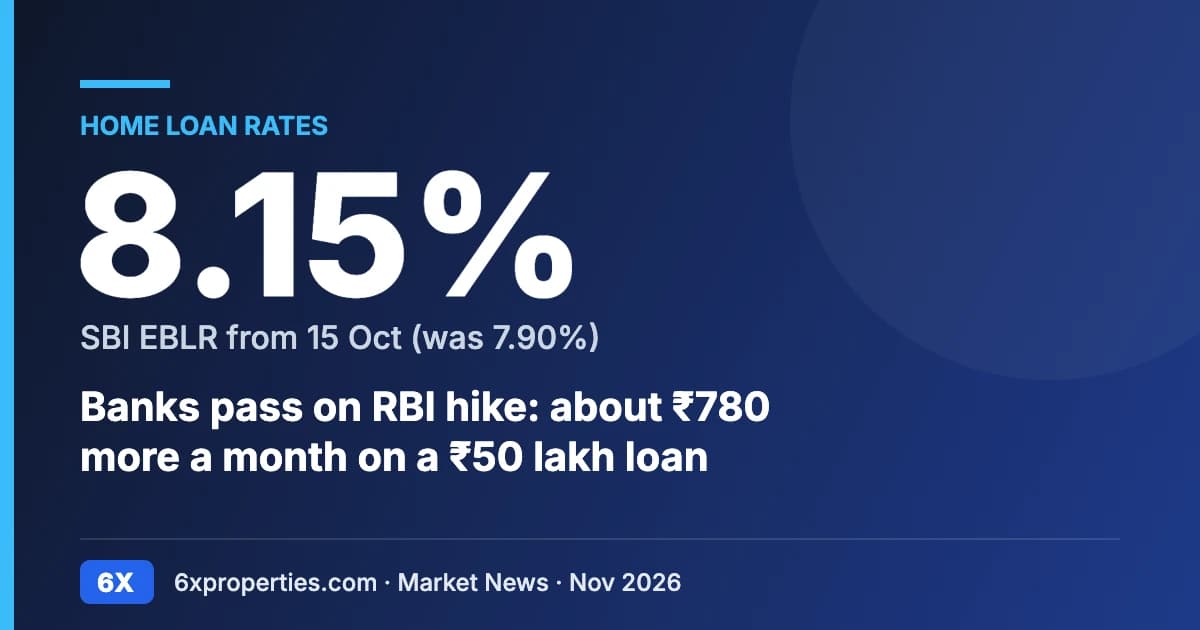
Home loans have become costlier across India's biggest public sector banks. Following the Reserve Bank of India's 25 basis point repo rate hike to 5.50% on 7 October 2026, State Bank of India raised its external benchmark lending rate (EBLR) to 8.15% from 7.90% with effect from 15 October, while Punjab National Bank, Bank of India and Indian Overseas Bank moved their repo-linked rates to 8.35%, Bank of Baroda to 8.15% and Indian Bank to 8.20%, all from 8 October. For a typical Delhi NCR or Uttarakhand borrower with a ₹50 lakh, 20-year floating-rate loan, a 0.25 percentage point rise adds about ₹780 a month, or nearly ₹1.9 lakh over the full tenure.
What happened
The RBI's Monetary Policy Committee raised the repo rate from 5.25% to 5.50% on 7 October 2026. We covered the policy decision itself in our earlier article on what the RBI repo rate hike means for your EMI. This piece focuses on the next step: how banks have actually passed the hike on to borrowers in the weeks since, and what you can do about it.
Because most new home loans since October 2019 are linked to an external benchmark — usually the repo rate — banks adjust their repo-linked lending rate (called RLLR, RBLR or EBLR depending on the bank) soon after the RBI acts. The bank's spread over that benchmark generally stays the same, so the full increase reaches the borrower at the next reset date.
Which banks have raised rates so far
Based on reports by ETV Bharat (8 October), Business Today (18 October) and Mint (27 October):
- State Bank of India: EBLR and RLLR raised by 25 bps, effective 15 October 2026. Mint reports the EBLR moving to 8.15% from 7.90%. Business Today lists SBI's regular home loan rates at 7.50% to 8.80%, Home Loan MaxGain at 8% to 9.30%, top-up loans at 8% to 10.75% and top-up overdrafts at 8.50% to 11.25%. Your exact rate depends on your credit profile and loan type.
- Punjab National Bank: RLLR raised from 8.10% to 8.35%, effective 8 October; PNB said the figure includes a business strategic premium of 0.35%. Its MCLR and base rate were not changed at that time.
- Bank of Baroda: repo-based lending rate up from 7.90% to 8.15%.
- Indian Bank: repo-based lending rate up from 7.95% to 8.20%, effective 8 October.
- Bank of India: repo-based lending rate raised to 8.35%.
- Indian Overseas Bank: repo-based lending rate raised to 8.35%.
- Tamilnad Mercantile Bank: RLLR raised by 25 bps to 8.50%.
HDFC Bank is a special case. Most of its newer home loans are linked to an external benchmark, but it also revised its marginal cost of funds based lending rates (MCLR). The ETV Bharat report on these MCLR changes is internally inconsistent — it describes a "cut" in the one-month MCLR but quotes figures that suggest a rise — so we are not reporting specific HDFC Bank numbers. Borrowers should check the bank's website or loan statement directly.
We did not find reports on ICICI Bank, Canara Bank or Union Bank of India in the sources we reviewed. Expect most lenders to follow the same direction; check your own bank's notice.
Key figures
- Repo rate: 5.50% (up from 5.25%), decided 7 October 2026
- SBI EBLR: 8.15% (from 7.90%), effective 15 October 2026
- PNB RLLR: 8.35% (from 8.10%), effective 8 October 2026
- Bank of Baroda RBLR: 8.15% (from 7.90%)
- Indian Bank RBLR: 8.20% (from 7.95%), effective 8 October 2026
- Bank of India and IOB RBLR: 8.35%
- Typical increase passed on: 0.25 percentage point
Our calculation: how much more you will pay
We used the standard EMI formula, EMI = P × r × (1 + r)^n ÷ ((1 + r)^n − 1), where P is the principal, r is the monthly interest rate and n is the number of months. These are our own illustrative figures for a fresh 20-year (240-month) loan; your actual EMI depends on your outstanding principal, remaining tenure and spread.
If your rate moves from 7.90% to 8.15%:
- ₹30 lakh loan: EMI rises from about ₹24,907 to ₹25,374, an increase of ₹467 a month (about ₹1.12 lakh over 20 years).
- ₹50 lakh loan: EMI rises from about ₹41,511 to ₹42,290, an increase of ₹779 a month (about ₹1.87 lakh over 20 years).
- ₹75 lakh loan: EMI rises from about ₹62,267 to ₹63,435, an increase of ₹1,168 a month (about ₹2.80 lakh over 20 years).
If your rate moves from 8.10% to 8.35%:
- ₹30 lakh: about ₹25,280 to ₹25,751 (+₹470 a month)
- ₹50 lakh: about ₹42,134 to ₹42,918 (+₹784 a month)
- ₹75 lakh: about ₹63,201 to ₹64,376 (+₹1,176 a month)
These line up with Business Today's estimate, citing BankBazaar, of about ₹781 a month extra on a ₹50 lakh loan with 20 years left, which used an 8% to 8.25% example.
If your bank keeps the EMI the same and extends the tenure instead: for a ₹50 lakh loan taken at 7.90% over 240 months, holding the EMI at ₹41,511 at 8.15% would stretch repayment to about 252 months — roughly a year longer. Total interest over a full 20 years rises from about ₹49.6 lakh at 7.90% to about ₹51.5 lakh at 8.15%.
Run your own numbers on our EMI calculator.
The "hidden cost" of moving to a cheaper rate
Many existing borrowers are paying more than new customers because their spread over the benchmark was set when they first took the loan. A common way to reduce this is to ask your bank to convert your loan to its current, lower spread. Mint's 27 October report explains that this is not free:
- Banks typically charge 0.25% to 0.50% of the outstanding principal plus GST, though some charge a flat fee, according to Kapil Makhija of MinEMI quoted by Mint.
- On a ₹60 lakh outstanding balance, a 0.5% fee would be ₹30,000, plus 18% GST.
- Mint reports HDFC Bank's conversion charge for certain fully disbursed home loans at 0.25% of the outstanding principal, capped at ₹5,000 plus taxes, and Kotak Mahindra Bank's at 0.5%, capped at ₹10,000 plus taxes, for switching between floating-rate schemes on certain loans.
- A separate charge may apply if you move from an old MCLR or base-rate loan to an external benchmark.
- Fixed-rate loans generally cannot be repriced this way.
Mint's report notes that an internal conversion with the same bank is generally cheaper and faster than a balance transfer to a new lender, which involves fresh processing fees, legal and valuation charges, and stamp duty on new documents in some states.
Is switching worth it? A quick rule of thumb
Compare the one-time cost with the monthly saving. Our illustration: if converting cuts your spread by 0.25 percentage point on a ₹50 lakh loan with about 20 years left, you save roughly ₹780 a month. A fee of ₹5,900 (₹5,000 plus GST) pays for itself in under eight months. A fee of 0.5% plus GST (about ₹29,500) takes just over three years. The bigger your outstanding loan and the longer the tenure left, the more a lower spread is worth.
What it means for buyers, sellers and investors
Existing borrowers in Delhi NCR and Uttarakhand
- Check your reset date. Repo-linked loans usually reset quarterly or at a date specified in your agreement. Look for the bank's notice or log into net banking.
- Decide: higher EMI or longer tenure. Banks often extend tenure by default. If you can afford it, choosing a higher EMI saves interest. If you are near retirement age, ask whether tenure can be extended at all.
- Ask for a spread reduction. If your credit score has improved since you took the loan, request conversion to the current rate card and compare the fee to your saving.
- Consider part-prepayment. Even one extra payment a year cuts the interest burden noticeably over a long tenure.
New buyers
- Budget with a margin. If you are buying in Noida, Greater Noida or Gurugram, plan your budget at a rate at least 0.5 percentage point above today's offer. Our home loan tips for Delhi NCR explain how much to keep aside for stamp duty, registration and interiors.
- Compare lenders. Spreads vary considerably by bank and credit score. Get written sanction letters from two or three lenders.
- Watch the festive offers. Some banks waive processing fees or offer concessions on spreads during the festive season. Read the conditions carefully.
Sellers and investors
A 0.25 point rise has a modest effect on affordability: on a ₹50 lakh loan it is under ₹800 a month. It is unlikely to change prices on its own, but repeated hikes could slow demand at the margin, especially in price-sensitive segments in Ghaziabad, Greater Noida West, Rudrapur and Kashipur. Sellers may find buyers asking for slightly more negotiation room. Investors relying on rental yield should recheck their numbers with the higher rate.
Browse homes in Noida or Rudrapur to see current asking prices.
Frequently asked questions
My bank has not sent me any message. Has my EMI changed?
If your loan is repo-linked, the new rate usually applies from your next reset date, which may be a few weeks or months away. Check your loan statement or the bank's app. If your loan is linked to MCLR, changes follow the MCLR reset cycle and may take longer.
Will my EMI go up or will my tenure be extended?
Many banks extend the tenure by default so the EMI stays the same. You can usually ask the bank to raise the EMI instead, which saves interest overall. Contact your branch or customer care in writing.
Is a balance transfer to another bank a good idea now?
It can be, if the new lender's rate is meaningfully lower and your remaining tenure is long. Factor in processing fees, legal and valuation charges, and any stamp duty. Mint's report suggests trying an internal conversion with your existing bank first.
Will rates go up further?
Nobody can say for certain. The RBI decides at each policy meeting based on inflation and growth. Plan your finances so a further 0.25–0.50 point rise would not strain your budget.
Does this affect fixed-rate home loans?
No. Fixed-rate loans do not change with the repo rate during the fixed period, but they usually start at a higher rate and may carry prepayment charges.
The bottom line
The October hike is now feeding through to borrowers. For most families the increase is a few hundred rupees a month per ₹30–50 lakh borrowed, but over 20 years it adds up to lakhs. The most useful steps are simple: check your reset date, choose a higher EMI over a longer tenure if you can, and ask your bank whether a lower spread is available — after comparing the conversion fee with your saving.
This article is for general information and is not financial advice. Rates are as reported by the sources below and may have changed; confirm with your lender.
Sources
- Business Today: SBI raises home loan rates by 25 bps — how much more will you pay every month? (18 October 2026)
- ETV Bharat: RBI repo rate hike — these banks have increased repo-linked lending rate (8 October 2026)
- Mint via TradingView: Banks raise home loan rates after RBI repo rate hike — want to move back to a lower-interest loan? Know this hidden cost (27 October 2026)
- Reserve Bank of India
Looking to buy, sell or rent?
Browse verified listings or list your property in minutes.